

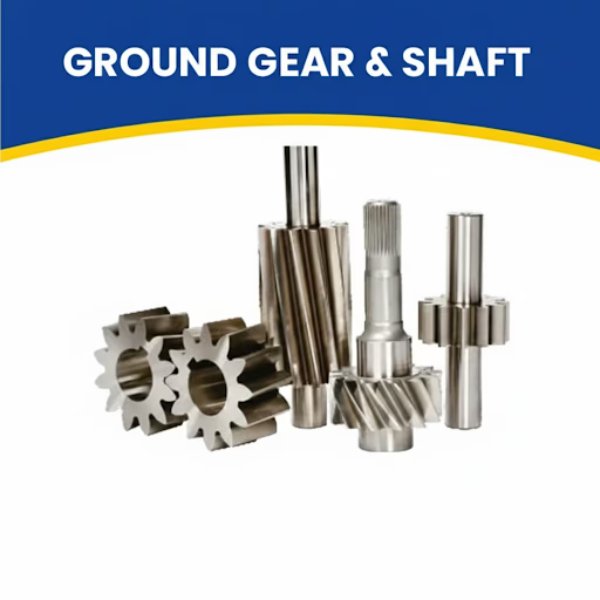
In machinery where accurate tooth engagement, controlled motion, or smooth power transfer is important, the final condition of the gear teeth can have a significant effect on performance. Precision grinding is used in suitable applications to achieve refined tooth geometry and surface characteristics after earlier manufacturing processes.
Engineering businesses assessing a Precision Ground Gears Supplier in New Delhi should therefore evaluate more than the visible finish of a gear.
Why Gear Grinding Is Used
Gear teeth can be produced through several manufacturing processes. Where tighter accuracy or refined tooth surfaces are required, grinding may form part of the finishing sequence.
Depending on the specification, gear grinding can support:
- Improved tooth geometry
- Better surface finish
- Controlled dimensional accuracy
- More consistent tooth contact
- Reduced deviations after heat treatment
The required level of finishing depends on the application.
Start With the Machine Requirement
Not every industrial gear needs the same degree of precision.
A buyer should first identify why a ground gear is required.
Possible reasons include:
- High rotational speed
- Controlled positioning
- Smooth transmission
- Noise considerations
- Tight assembly tolerances
- Demanding load conditions
- OEM drawing requirements
This prevents unnecessary manufacturing requirements while ensuring critical applications receive appropriate attention.
Examine Material Selection
The gear material needs to suit both the manufacturing process and operating environment.
Material choice can influence hardness, wear resistance, fatigue characteristics, machinability, and response to heat treatment.
The supplier should receive the specified material grade whenever the gear is being manufactured to an approved engineering drawing.
Understand the Role of Heat Treatment
Heat treatment can improve mechanical properties, but it may also introduce dimensional changes.
For applications requiring precision ground gears, the manufacturing sequence needs to account for these effects.
Grinding after relevant treatment stages can be used where the specification requires final tooth geometry to meet tighter tolerances.
Ask About Inspection
Visual appearance alone cannot establish gear accuracy.
Depending on the requirement, inspection may need to consider:
- Tooth profile
- Lead characteristics
- Pitch variation
- Runout
- Dimensions
- Bore relationship
- Surface condition
OEM buyers should define required inspection criteria in their drawings or purchase specifications.
Check Mating Components
A high-quality precision gear cannot correct every problem elsewhere in a machine.
Shaft runout, bearing condition, housing accuracy, alignment, and the mating gear can all affect actual operating performance.
If a newly installed gear develops unusual wear, engineers should examine the complete assembly before assuming the gear itself is responsible.
Evaluate the Supplier Beyond Unit Price
For high-accuracy components, procurement teams should assess manufacturing capability, understanding of drawings, material control, finishing requirements, and inspection practices.
OPTIGEAR manufactures and supplies industrial gears and related power transmission components from New Delhi for engineering and machinery applications.
For OEMs in Delhi and the surrounding industrial region, sharing drawings and application information helps establish whether precision grinding is appropriate for the component.
Precision ground gears are most valuable when the entire engineering requirement supports their use. Correct material, heat treatment, tooth geometry, inspection, installation, and mating components must all work together to achieve dependable machine performance.