
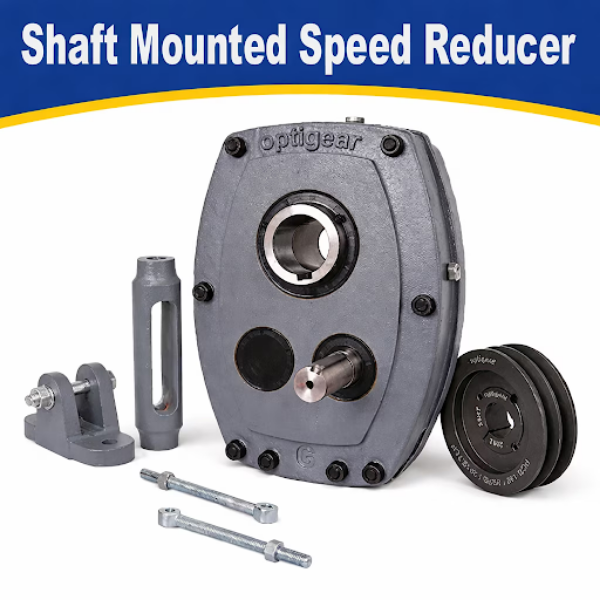
Conveyor systems frequently need compact and dependable speed reduction between the drive motor and conveyor shaft. A shaft mounted reducer can provide a practical arrangement because the unit is mounted directly onto the driven shaft, reducing the need for some conventional drive components.
When evaluating a Shaft Mounted Speed Reducer Manufacturer in New Delhi, buyers should focus on application requirements rather than selecting a reducer solely from motor power or physical dimensions.
Why Shaft Mounted Reducers Are Used
The direct mounting arrangement can simplify conveyor drive layouts and make efficient use of available installation space.
These reducers are commonly considered for:
- Belt conveyors
- Material handling systems
- Aggregate handling
- Industrial processing
- Mining-related equipment
- Construction material systems
Their suitability still depends on correct engineering selection.
Calculate the Required Ratio
The gearbox ratio determines how input speed is converted to output speed.
For example, if a motor operates significantly faster than the required conveyor shaft speed, the reducer must provide an appropriate reduction ratio.
Selecting the wrong ratio can result in a conveyor moving too quickly or too slowly for the process.
Evaluate Torque Requirements
Output torque is a critical selection parameter.
The reducer must handle the torque required during normal operation as well as realistic starting and transient conditions.
Conveyors carrying heavy materials can experience considerably higher starting loads than their steady running loads suggest.
Consider Service Conditions
A conveyor operating for a few hours per day under a uniform load presents a different duty from a continuously running system handling heavy or irregular material.
Buyers should communicate:
- Daily operating duration
- Number of starts
- Load variation
- Shock conditions
- Ambient temperature
- Dust exposure
- Installation environment
These details influence reducer sizing and service expectations.
Examine Mounting Requirements
Shaft diameter and mounting arrangement must match the driven equipment.
Incorrect dimensions can create installation difficulties or poor load transfer.
The torque arm arrangement should also be reviewed because it restrains the gearbox housing while allowing the output shaft to transmit rotational force.
Do Not Ignore Lubrication
Lubrication protects internal gears and bearings from excessive friction and wear.
Maintenance teams should follow the lubricant grade, quantity, replacement interval, and inspection practices appropriate for the reducer.
Oil leakage, contamination, unusual temperature increases, or changes in operating sound should be investigated rather than ignored.
Compare Suppliers Using Technical Information
A meaningful comparison should go beyond price.
Ask prospective suppliers about:
- Available ratios
- Torque capacity
- Shaft compatibility
- Gear construction
- Mounting configuration
- Application suitability
- Technical documentation
- Spare support
For industrial users in Delhi, proximity to an engineering supplier can also make technical communication and component coordination easier.
OPTIGEAR manufactures and supplies industrial power transmission equipment from New Delhi, including solutions intended for demanding machinery and conveyor applications.
A shaft mounted speed reducer should ultimately be selected around the conveyor's real operating conditions. Correct ratio, torque capacity, mounting, duty cycle, and maintenance planning are far more important than choosing a unit simply because its external dimensions appear suitable.