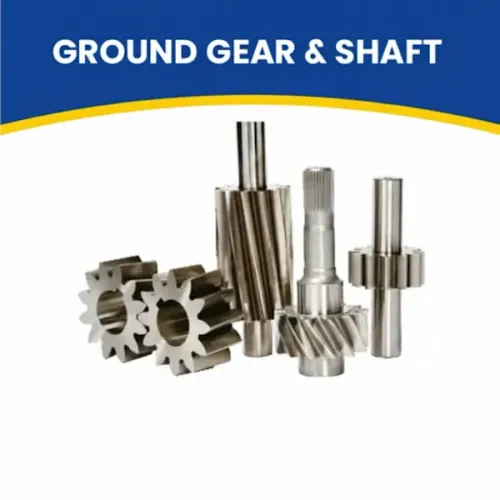

Gear shafts often perform multiple functions within a compact mechanical assembly. They may transmit torque, carry gears, locate bearings, interface with couplings, and maintain alignment between rotating components. Because of this combination of responsibilities, custom gear shafts require careful attention to dimensions, materials, machining accuracy, and operating loads.
OEMs evaluating a Custom Gear Shaft Manufacturer in New Delhi should use a technical qualification process rather than making a decision based primarily on quotation value.
Begin With a Complete Drawing
A detailed engineering drawing provides the clearest basis for manufacturing.
It should define relevant information such as:
- Overall dimensions
- Shaft diameters
- Gear geometry
- Keyways
- Splines where applicable
- Bearing seats
- Threads
- Shoulders
- Tolerances
- Surface finish requirements
Critical dimensions should be identified clearly rather than leaving the manufacturer to infer their importance.
Specify Material Correctly
Material selection affects shaft strength, fatigue resistance, wear characteristics, and response to heat treatment.
The correct grade depends on torque, speed, geometry, shock loading, and the intended machinery.
OEM drawings should specify material requirements wherever these have already been established through design calculations or previous validation.
Identify Critical Fits
Bearing seats, coupling locations, gear interfaces, and other mating surfaces may require controlled tolerances.
If these dimensions are incorrect, assembly can become difficult even when the rest of the shaft appears acceptable.
Procurement teams should therefore distinguish functional dimensions from less critical features.
Consider Gear Tooth Requirements
When the gear is integral to the shaft, tooth manufacturing becomes part of the overall shaft quality.
Relevant specifications may include gear type, module, number of teeth, pressure angle, tooth width, heat treatment, and required accuracy.
The relationship between the gear teeth and shaft datum surfaces can also be important.
Review Heat Treatment Requirements
Depending on the application, custom gear shafts may require specific hardness or mechanical properties.
Heat-treatment requirements should be defined early because they can affect the manufacturing sequence and final dimensions.
Where tight tolerances are required after treatment, additional finishing operations may be necessary.
Ask How Components Are Inspected
A supplier should be able to work against clearly defined acceptance requirements.
Inspection may include dimensional verification, runout checks, gear-related measurements, hardness verification, or other parameters specified by the buyer.
The required documentation should be agreed before production begins.
Evaluate Repeat Manufacturing Capability
For OEMs, one successful prototype is only the beginning.
If a component will enter regular production, consistency between batches becomes important.
Ask how drawings, manufacturing specifications, and inspection requirements are controlled for repeat orders.
This can be particularly relevant for machinery manufacturers serving automotive ancillary, material handling, textile, construction, cement, mining, and industrial processing sectors.
Consider Replacement Support
Custom components can become difficult to source years after a machine enters service.
Maintaining controlled drawings and manufacturing records can make future replacements considerably easier.
For New Delhi-based OEMs and engineering companies, working with a technically accessible supplier can also simplify drawing discussions and component development.
OPTIGEAR manufactures industrial gears, gear shafts, gearboxes, and power transmission components from New Delhi for machinery applications requiring engineered mechanical solutions.
The strongest indicator of a suitable custom gear shaft manufacturer is not simply the ability to machine the part. It is the ability to understand drawings, work with specified materials and tolerances, address gear requirements, support inspection, and reproduce the component consistently when future production demands it.